What Does Jammu & Kashmir Export to the World? Saffron, Pashmina, Carpets, Walnuts and More
When people think of Jammu and Kashmir, they visualize snow-capped mountains, Dal Lake and apple orchards. However, traders see another aspect of the region - its saffron, Pashmina shawls, hand-knotted carpets and walnuts, which have gained popularity across the world, including in the Middle East, Europe and North America. What products does Jammu and Kashmir export to the rest of the world?
This article provides an in-depth analysis of the leading export items from Jammu & Kashmir (J&K), illustrates how J&K's export/import picture is integrated with other regions of India, and examines NITI Aayog's Export Preparedness Index to assess whether or not J&K has the potential to become a global competitor.
Key Takeaways
- The top products exported from Jammu & Kashmir include: Kashmir saffron, pashmina and woollen products, carpets and handicrafts and walnuts.
- Jammu and Kashmir ranked second among the categories of small states, North East States and Union Territories in the Export Preparedness Index (EPI) of NITI Aayog.
- Its overall EPI rank is 14th among all States and UTs.
- The long-standing tradition of skilled crafts, coupled with the geographical indication (GI) tag, provides products from Jammu and Kashmir with an advantage when competing in the world market.
- The biggest challenges for exporters include logistics, quality certification and counterfeiting.
How Prepared Is Jammu & Kashmir for Exports? The EPI Ranking
The Export Readiness Index (ERI) is a ranking of all states and union territories in terms of how ready each one is to promote and expand its exports. The ERI measures this readiness through four main areas: Policy, Business Environment, Export Environment and Export Performance.
Here is where Jammu & Kashmir stands:
- 2nd position in the Small States, North East States, and Union Territories category.
- 14th rank overall among all States and UTs.
This will be a huge indicator for an area with an extremely challenging landscape, a very small manufacturing sector, and a long record of logistical issues. This will inform exporters, investors and decision-makers that J&K’s export capacity is growing and its goods can be sold on a national level as well as within the region.
Top Products J&K Exports to the World
Kashmir Saffron Export
Known as “red gold”, Kashmir saffron ranks as one of the world's highest-priced spices. Saffron is produced primarily in Pulwama (Pampore), Budgam, Srinagar, and Kishtwar and is collected from the fields during the fall season using hands.
Approximately 150,000 blossoms are required to yield just one kilogram of dry saffron, therefore making it an expensive product.
- High levels of crocin, safranal and picrocrocin – these are the chemicals responsible for saffron’s rich color, aroma and taste.
- The top “Mongra” grade consists of pure deep-red stigmas.
- It has a Geographical Indication (GI) tag, which protects its authenticity.
- Demand comes from food, pharmaceuticals, cosmetics and wellness brands.
India's imports of saffron (primarily from Iran and other producing countries) make it a competitive product in the Indian domestic market as well as internationally for Kashmir saffron. Therefore, the best way to earn the confidence of buyers is through GI certification, ISO 3632 quality testing and clear grading systems.
Pashmina & Woollen
The Kashmir Pashmina shawl is an iconic product exported by India. This ultra-fine fiber is produced from the Changthangi goat, This breed thrives at extremely high elevations in neighboring Ladakh. After being harvested, artisans in Kashmir use traditional methods to spin, weave and sometimes embroider the fiber into shawls, stoles and scarves.
What makes it special:
- Exceptionally soft, light and warm, with a long product life.
- Signature techniques such as Kani weaving and Sozni embroidery.
- Genuine Pashmina is separated from machine-made imitations by being protected under a Geographical Indication (GI) label.
- Strong demand in the USA, UK, Europe, Japan and the Middle East.
- Woollen products like blankets, stoles and winter clothes add variety to the product line and assist in providing year-round income for the artisan.
Carpets & Handicrafts
Hand-knotted carpets, produced in woollen and silk from Kashmir are collector's items. It can take several months for one carpet to be completed. To create each carpet, the weaver follows a coded design sheet referred to as "talim". As a general rule, the higher the number of knots per square inch, the better quality of carpet is produced, and therefore, the more valuable it becomes.
Beyond carpets, J&K’s handicraft basket includes:
- Papier-mâché art
- Walnut wood carving
- Namda and Gabba rugs
- Crewel embroidery
- Copperware and willow wicker products
A number of these products have been given a GI tag, and as a whole, employ a huge number of artisans. With the help of online marketplaces, and business-to-business (B2B) trade platforms, many small-scale producers can sell their wares directly to customers around the world.
Walnut
The Jammu & Kashmir state has been a leading producer of walnuts within India. It is believed to produce the majority of all walnuts in the country (estimated by many sources to be approximately 90%). The Kagzi variety of walnut (thin-shelled) is grown throughout both the Kashmir valley and the Chenab region. The Kagzi variety of walnut is preferred due to the ease with which it can be cracked and its sweet-tasting kernel.
Walnut has many different export opportunities, including in-shell walnuts and shelled kernel walnuts that will be exported to the dry fruit market. Also exported are walnut oil and byproducts used in food and cosmetics manufacturing. Additionally, the wood from the walnut tree is exported to feed the carving industry. Therefore, walnut can be considered one of the most diverse products available to the trade community of Jammu and Kashmir.
Trade Notes: India has been importing huge amounts of walnuts (particularly) from countries like the USA & Chile. Therefore, quality grading, consistent grading standards, and updated packaging methods will be required for J&K produced walnuts to compete with imported walnuts on the Indian market, as well as gain market share internationally.
Exports and Imports at a Glance
Here is a quick reference for traders. HS codes are indicative, so always confirm them against the latest customs tariff before filing.
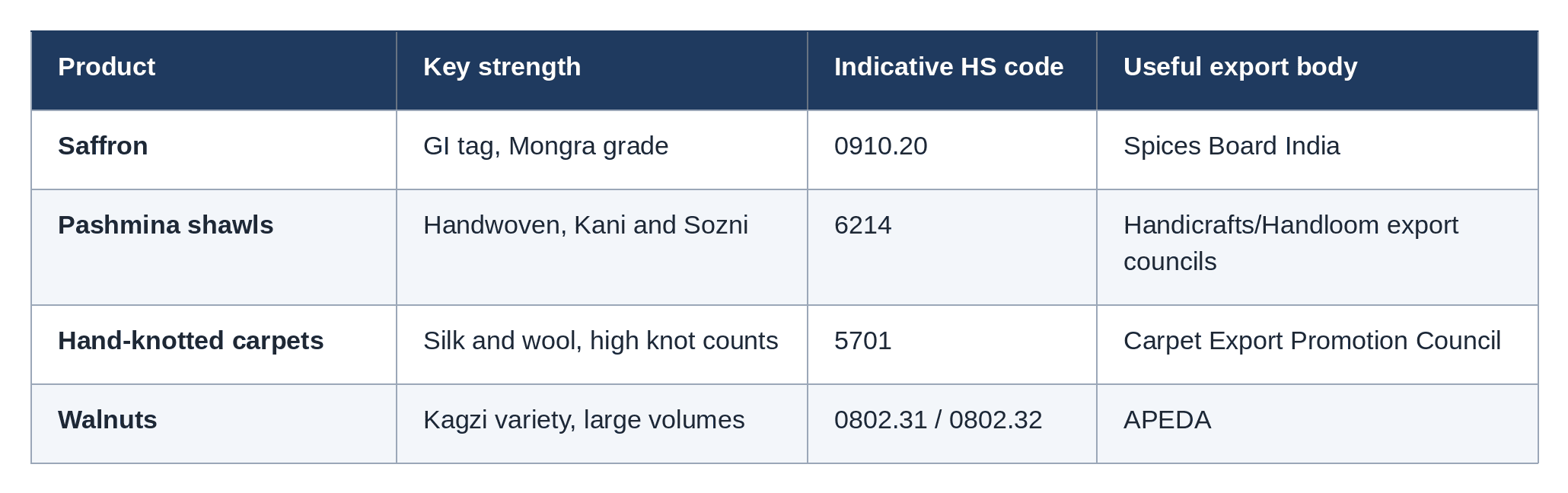
On the import side, J&K’s producers also depend on inputs such as dyes, yarn and packaging material, and they compete with imported saffron and walnuts in the domestic market. Understanding both sides of the exports and imports equation helps businesses price smartly, manage costs and find the right buyers.
What Is Driving J&K’s Export Growth?
- GI tags and Branding: Authenticity is a major selling point in luxury and gourmet markets.
- Government Focus on Exports: Initiatives such as district-level export action plans and the National Saffron Mission aim to improve quality and market access.
- Better Connectivity: Improving road, rail and air links is shortening the journey from orchard and loom to port.
- Digital Trade: B2B portals and e-commerce let even small artisans find global buyers.
Challenges J&K Exporters Still Face
- Logistics: Mountainous terrain and weather disruptions can delay shipments.
- Counterfeits: Machine-made imitations sold as Pashmina or Kashmir saffron hurt genuine producers.
- Compliance: Many small producers need help with documentation, certification and customs.
- Scale and Packaging: Global buyers expect consistent quality, grading and export-ready packaging.
The EPI ranking suggests the region is already tackling these gaps. The next step is stronger value addition, traceability and market linkages.
How to Start Exporting from Jammu & Kashmir
- Get your IEC: Obtain an Importer Exporter Code (IEC) from DGFT.
- Register with the right body: Join the relevant export promotion council or board and get your RCMC.
- Certify your product: Use GI authentication, ISO or lab testing, and the required quality and phytosanitary certificates.
- Get your HS code and documents right: Invoices, packing lists and shipping bills must match your classification.
- Find verified buyers: Use trade data, B2B platforms and trade fairs to research demand and pricing.
- Choose a reliable logistics partner: Compare freight options, transit times and costs before you ship.
Conclusion
The state of Jammu and Kashmir has grown to be a major exporter of many goods. These include saffron from the area of Pampore, Pashmina made by local artisans on looms in Srinagar, carpet weaving, handicraft making, walnut harvesting and others. Additionally, J&K was ranked 1st in the NITI Aayog's Export Preparedness Index and is in a good position to increase its global export market share.
If you’re a company looking to export to other countries, or if you’re a company importing from India, there is a very large amount of potential in both directions.
Use Zipaworld to find export and import opportunities and get connected to the tools, insights and partners that will help make international business much easier.