
Reverse Logistics Explained: Returns, Recycling & ROI
Introduction: Evolution of Reverse Logistics
The logistics industry has undergone a major transformation with the rise of reverse logistics, driven by the rapid growth of eCommerce and disruptions caused by the COVID-19 pandemic. What was once considered a secondary process handling returns has now become a critical part of modern supply chain management.
Today, businesses are redesigning their supply chains to handle increasing return volumes, improve customer satisfaction, and build more resilient logistics systems.
Understanding Reverse Logistics
Reverse logistics refers to the process of moving goods from the customer back to the seller or manufacturer after the point of sale. Unlike traditional logistics, which focuses on product delivery, reverse logistics focuses on product recovery, reuse, recycling, or disposal.
Originating in the 1990s, reverse logistics has now evolved into a structured supply chain function that supports sustainability, cost recovery, and operational efficiency.
Reverse Logistics Process Flow
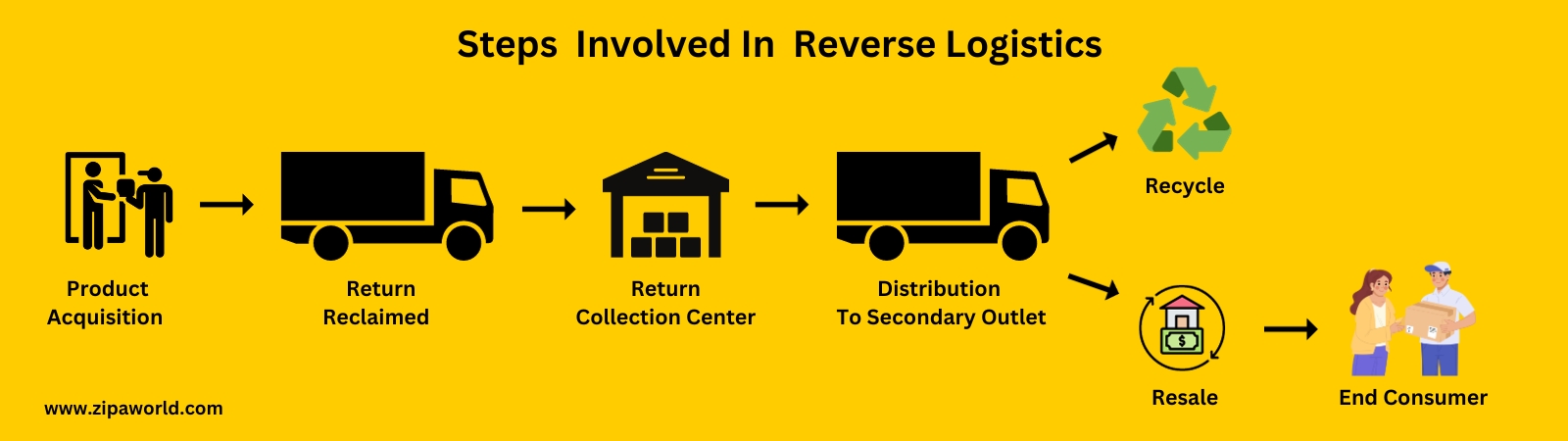
The reverse logistics process typically involves the following stages:
1. Product Return Initiation
2. Customers initiate returns due to defects, dissatisfaction, or replacements.
3. Collection & Transportation
4. Returned goods are transported to a designated return or collection center.
5. Inspection & Sorting
6. Products are evaluated based on condition and categorized for further action.
7. Disposition Decision
8. Items are either:
- Refurbished
- Repaired
- Recycled
- Resold
- Discarded
9. Secondary Distribution
10. Refurbished or resale-ready products are reintroduced into the market.
Modern systems increasingly rely on automation, AI-based sorting, barcoding, and tracking technologies to improve efficiency and accuracy.
Key Benefits of Reverse Logistics
Reverse logistics offers several strategic advantages for businesses:
- Improves customer satisfaction through flexible return policies
- Reduces operational losses by recovering product value
- Enhances supply chain visibility and efficiency
- Supports sustainability through recycling and reuse
- Helps identify product defects and reduce future returns
Companies like Zipaworld help businesses streamline logistics operations by improving visibility and coordination across supply chain processes.
Challenges in Reverse Logistics
Despite its benefits, reverse logistics presents several challenges:
- Managing high and unpredictable return volumes
- Educating customers on return processes
- Lack of real-time tracking and visibility
- High operational and processing costs
- Compliance with environmental and disposal regulations
To overcome these challenges, businesses are increasingly adopting digital logistics platforms and automation-driven systems.
Technology in Reverse Logistics
Technology plays a key role in modern reverse supply chains:
- Automation for faster sorting and processing
- Barcode & RFID systems for tracking returned goods
- AI & analytics for return prediction and decision-making
- Cloud-based systems for real-time inventory visibility
- Blockchain for transparency and traceability
These innovations help reduce inefficiencies and improve decision-making across the reverse supply chain.
The Future of Reverse Logistics
The future of reverse logistics is driven by automation, sustainability, and digital transformation. Businesses are shifting toward closed-loop supply chains where returned products are reintegrated into the value chain instead of being treated as waste.
This transformation enables cost savings, environmental responsibility, and improved customer trust.
Logistics providers like Zipaworld are playing an important role in enabling this shift by supporting smarter, technology-driven supply chain solutions.
Conclusion
Reverse logistics is no longer a secondary function it is a strategic pillar of modern supply chain management. By integrating technology, improving processes, and adopting sustainable practices, businesses can transform returns into opportunities.
As eCommerce continues to expand, reverse logistics will remain essential for efficiency, profitability, and customer satisfaction in the evolving global logistics landscape.