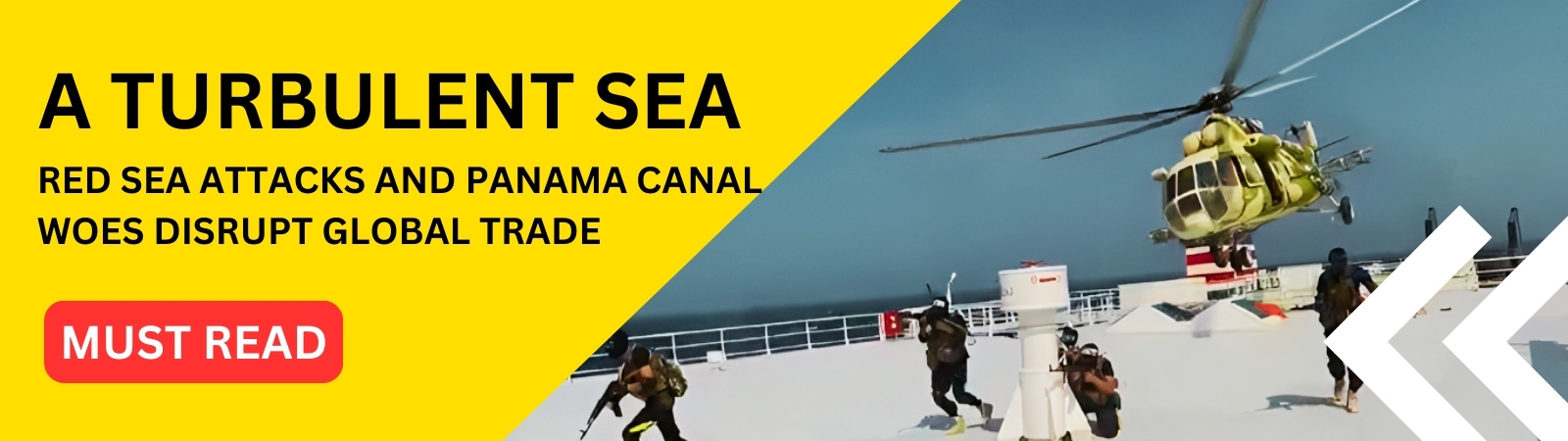
Red Sea Attacks and Panama Canal Woes Disrupt Global Trade
The Red Sea, a shimmering ribbon connecting Asia, Africa, and Europe, has become a storm-tossed battleground, sending shockwaves through the global trade network. Recent drone attacks on vessels traversing this vital artery have raised serious concerns about the free flow of goods and the economic consequences for nations, including India.
Red Sea: A Maritime Lifeline Under Threat
The Red Sea, accounting for 12% of global trade and 30% of container traffic, serves as a crucial link in the global supply chain. With the Suez Canal shortening voyages between the East and West, the Red Sea acts as a bridge for millions of containers carrying everything from electronics and garments to oil and agricultural products.
However, this strategic passage has become a target. Houthi rebels, suspected to be backed by Iran, have launched drone attacks on commercial ships, raising the specter of a wider conflict and pushing major shipping lines like Maersk and MSC to reroute their vessels via the lengthy Cape of Good Hope, adding days and substantial costs to their journeys.
India in the Crosshairs
The Red Sea crisis has directly impacted India, a nation heavily reliant on maritime trade. Two recent attacks targeting Indian ships, the "MV CHEM PLUTO" and "MV Sai Baba," have sent a chilling message. While no casualties were reported, the incidents highlight the vulnerability of Indian trade and the potential for further escalation.
With 20% of Indian exports passing through the Suez Canal and Red Sea route, the disruption translates to significant economic repercussions. Vessel insurance costs skyrocketing and freight charges surging by 30-40%. This, in turn, threatens inflation and squeezes consumer spending.
Panama Canal: Another Bottleneck
Adding to the global trade woes is the Panama Canal, facing its worst drought in decades. Water levels have dipped alarmingly, forcing ships to lighten their cargo or take longer routes, further adding to delays and pushing up freight costs. The situation has driven LNG vessels to participate in expensive auctions to expedite their passage through the canal, highlighting the desperation to keep trade flowing.
Global Trade in a Chokehold
Together, the Red Sea and Panama Canal crises have created a perfect storm for global trade. Freight prices have soared, transit times have lengthened, and uncertainty hangs heavy in the air. Shipping lanes are scrambling to adjust, with Maersk announcing the suspension of services through the Red Sea and rerouting vessels via the Cape of Good Hope.
The consequences are far-reaching, impacting everything from consumer goods to essential commodities. For developing economies like India, the impact is particularly acute, threatening to stifle economic growth and exacerbate inflation.
A Glimmer of Hope: Operation Prosperity Guardian
In the face of this crisis, a glimmer of hope has emerged in the form of "Operation Prosperity Guardian," a US-led multinational coalition formed in December 2023. Comprising ten nations, this initiative aims to secure shipping lanes in the Red Sea by deploying warships to accompany cargo vessels. This proactive response could help deter further attacks and stabilize the situation.
The Way Forward: Resilience and Adaptation
The Red Sea and Panama Canal crises serve as a stark reminder of the fragility of global trade. It underscores the need for robust infrastructure, diversified supply chains, and a collaborative approach to manage risk and ensure the smooth flow of goods.
For India, this means investing in alternative trade routes, fostering domestic manufacturing, and promoting regional cooperation to build resilience against future disruptions. Technological advancements like automation and blockchain can also play a key role in streamlining logistics and enhancing transparency.
The turbulence in the Red Sea and the sluggish flow through the Panama Canal are a wake-up call for the world. By embracing resilience, fostering cooperation, and investing in innovative solutions, the international community can navigate these choppy waters and steer global trade toward a brighter future.