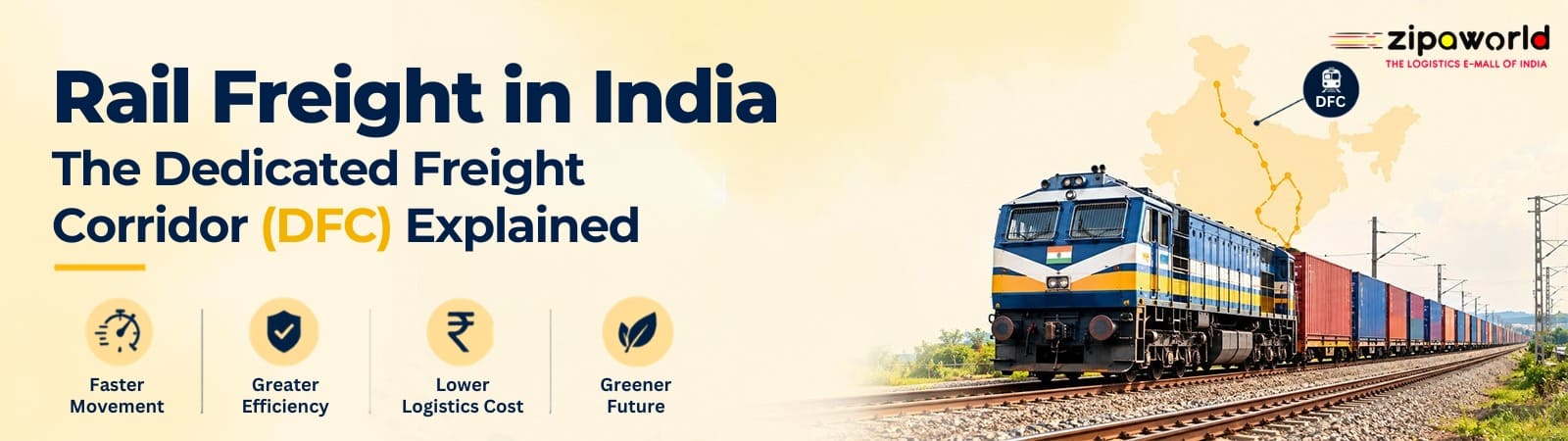
Rail Freight in India: The Dedicated Freight Corridor (DFC) Explained
India’s freight transportation network is changing rapidly as businesses look for faster, more reliable, and more cost-efficient ways to move cargo across the country.
One of the most important developments in this transformation is the Dedicated Freight Corridor, commonly known as the DFC.
The Dedicated Freight Corridor is a high-capacity railway network designed specifically for freight trains. Unlike conventional railway lines, where passenger and cargo trains share the same tracks, DFC routes are built to prioritize freight movement.
For manufacturers, exporters, importers, logistics companies, eCommerce businesses, and supply chain operators, the DFC has the potential to improve transit reliability, reduce transportation costs, increase freight capacity, and strengthen connections between industrial hubs, inland logistics centers, and major ports.
This guide explains Rail Freight in India, what the Dedicated Freight Corridor is, how it works, its major routes, its benefits, and why it matters for the future of Indian logistics.
What Is the Dedicated Freight Corridor in India?
The Dedicated Freight Corridor (DFC) is a railway infrastructure project developed to create separate rail corridors specifically for cargo transportation.
The objective is simple: move freight trains away from heavily congested passenger railway routes and provide dedicated tracks designed for high-capacity cargo movement.
The DFC network primarily includes two major corridors:
- Western Dedicated Freight Corridor (WDFC)
- Eastern Dedicated Freight Corridor (EDFC)
Together, these corridors connect important industrial regions, logistics hubs, mining areas, manufacturing centers, ports, and consumption markets.
The DFC is an important part of India’s broader effort to improve rail freight transportation, multimodal logistics, and supply chain efficiency.
Rail Freight in India: Why It Matters
India has one of the largest railway networks in the world, and rail has historically played an important role in transporting bulk cargo.
Common goods transported by rail include:
- Coal
- Cement
- Steel
- Iron ore
- Food grains
- Fertilizers
- Petroleum products
- Automobiles
- Containers
- Industrial raw materials
Rail freight is especially suitable for heavy cargo and long-distance transportation.
Compared with road transportation, rail can move significantly larger cargo volumes in a single journey.
For businesses managing long-distance Cargo Freight, this can provide advantages in both transportation cost and capacity.
Why Was the Dedicated Freight Corridor Needed?
India’s conventional railway network has traditionally carried both passenger and freight trains on the same tracks.
Passenger trains usually receive operational priority.
As a result, freight trains can experience:
- Longer transit times
- Unpredictable schedules
- Route congestion
- Extended waiting periods
- Lower average speeds
- Reduced network capacity
The Dedicated Freight Corridor was designed to address these challenges.
By separating cargo trains from passenger traffic, the DFC can help freight trains operate more consistently and efficiently.
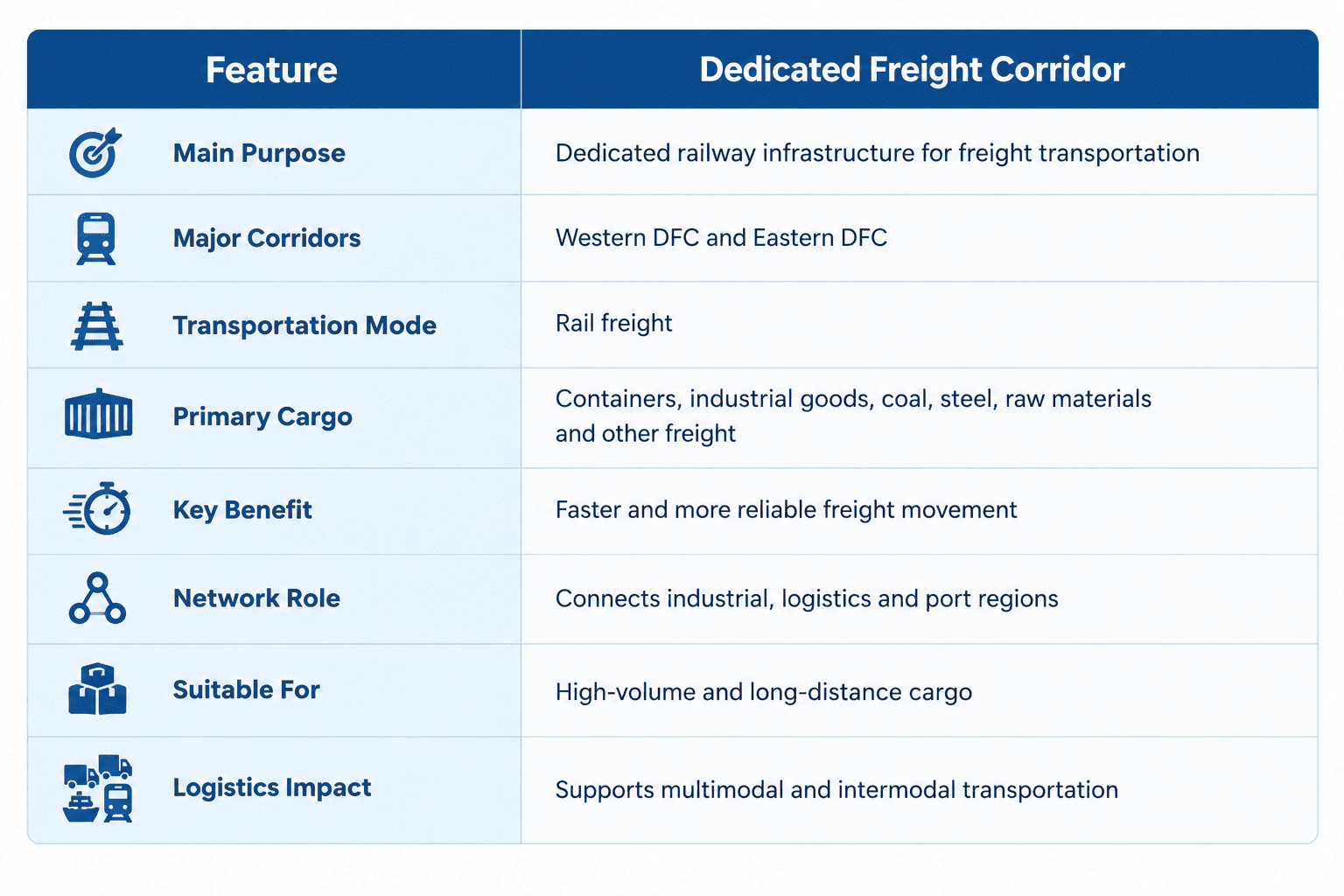
Dedicated Freight Corridor: Quick Overview
What Is the Western Dedicated Freight Corridor?
The Western Dedicated Freight Corridor, or WDFC, connects western and northern parts of India.
It was designed to strengthen freight connectivity between the Delhi-region industrial belt and western ports.
The corridor is particularly important for containerized cargo because western India contains several major ports and manufacturing regions.
The WDFC supports movement between areas associated with states such as:
- Uttar Pradesh
- Haryana
- Rajasthan
- Gujarat
- Maharashtra
Its strategic importance comes from connecting inland manufacturing and consumption centers with major western maritime gateways.
For companies involved in Ocean Freight, the Western DFC can help connect inland cargo with ports through rail-based container transportation.
Why Is the Western DFC Important for Container Shipping?
India’s western coast handles a significant share of the country’s containerized international trade.
Containers arriving at ports must often travel hundreds or thousands of kilometers to inland destinations.
Traditionally, much of this movement has depended heavily on trucks.
Rail-based freight corridors provide an alternative.
Containers can move between:
- Ports
- Inland Container Depots
- Logistics parks
- Industrial clusters
- Warehouses
- Manufacturing centers
This creates stronger integration between Ocean Freight Forwarding and Inland Rail Transportation.
What Is the Eastern Dedicated Freight Corridor?
The Eastern Dedicated Freight Corridor, or EDFC, serves important freight routes across northern and eastern India.
It was designed particularly to support high-volume freight movement involving industrial and resource-heavy regions.
The corridor connects areas associated with states such as:
- Punjab
- Haryana
- Uttar Pradesh
- Bihar
- Jharkhand
- West Bengal
The Eastern DFC supports cargo movement involving commodities such as:
- Coal
- Steel
- Cement
- Food grains
- Industrial products
- Raw materials
This can improve freight connectivity between mining regions, power plants, industrial areas, and major consumption centers.
Western DFC vs Eastern DFC
The two corridors have different freight profiles.
Western Dedicated Freight Corridor
The WDFC is particularly important for:
- Container cargo
- Port connectivity
- Manufacturing
- Automotive cargo
- Consumer goods
- Export-import logistics
Eastern Dedicated Freight Corridor
The EDFC has historically been more closely associated with:
- Coal
- Steel
- Minerals
- Cement
- Food grains
- Bulk industrial cargo
Together, the corridors form a major backbone for the modernization of rail freight in India.
How Does Rail Freight Work on the DFC?
A typical freight movement may involve several transportation stages.
For example:
- Cargo is collected from a factory or warehouse.
- It is transported by truck to an Inland Container Depot or logistics terminal.
- Cargo is loaded into containers or rail wagons.
- The freight train travels along the Dedicated Freight Corridor.
- Cargo reaches another inland terminal or port-connected logistics facility.
- The container is transferred to road transport or a vessel.
- Final delivery takes place at the destination.
This combination of rail, road, and sea transportation is known as multimodal logistics.
How the DFC Supports Multimodal Logistics
The Dedicated Freight Corridor is not designed to replace road or sea transportation.
Instead, it works alongside them.
A shipment may use:
- Road freight for first-mile pickup
- Rail freight for long-distance transportation
- Ocean freight for international movement
- Road freight again for final-mile delivery
This creates a multimodal transportation network.
For logistics providers, the objective is to use the most suitable mode for each stage of the journey.
Rail Freight vs Road Freight in India
Both transportation modes have advantages.
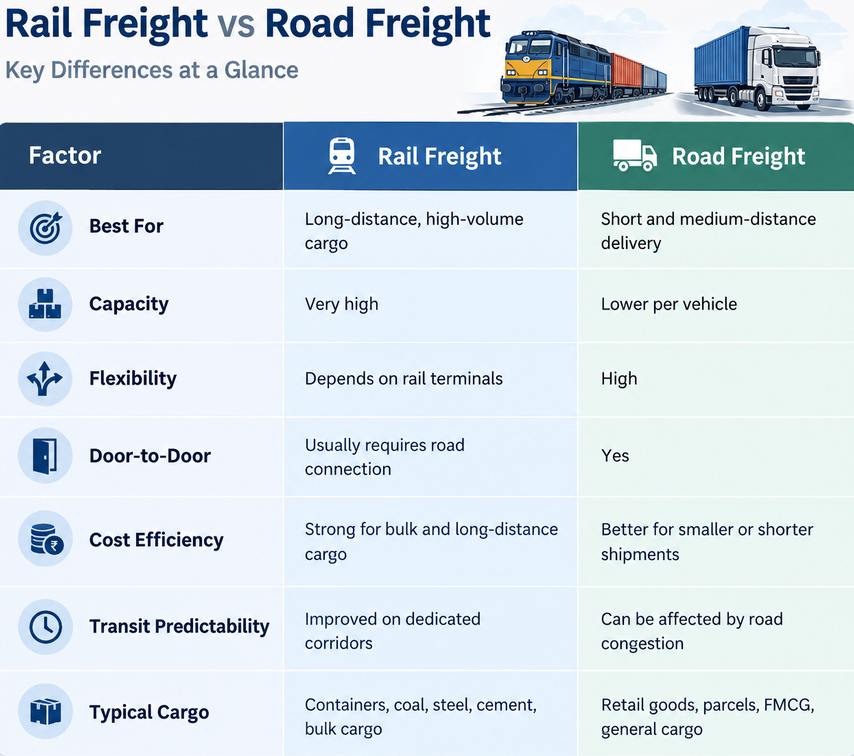
In practice, rail and road often complement each other.
Rail handles the long-distance portion, while trucks manage first-mile and last-mile transportation.
Rail Freight vs Sea Freight
Rail freight and sea freight also play different roles.
Sea freight is mainly used for international and coastal transportation, while rail freight is primarily used for inland cargo movement.
For imports and exports, the two can work together.
For example:
A container may arrive at an Indian port through Ocean Freight shipping, move inland by DFC rail, and then be delivered to the final consignee by truck.
This integration can make international freight movement more efficient.
Key Benefits of the Dedicated Freight Corridor
The DFC provides several potential advantages for India’s logistics ecosystem.
1. Higher Freight Capacity - Dedicated tracks allow larger volumes of cargo to move without competing directly with passenger trains.
2. Faster Freight Transit - Freight trains can operate more efficiently when they do not need to wait frequently for passenger services.
3. Better Schedule Reliability - More predictable rail operations can help businesses plan inventory and production schedules.
4. Lower Logistics Costs - Efficient long-distance rail transportation can reduce transportation costs for high-volume cargo.
5. Reduced Pressure on Highways - Moving more cargo by rail can reduce the number of long-distance trucks required on major highways.
6. Improved Port Connectivity - Rail corridors can strengthen connections between ports and inland industrial regions.
7. Support for Multimodal Logistics - The DFC encourages integration between rail, road, ports, ICDs, warehouses, and logistics parks.
How the DFC Helps Indian Exporters
Exporters often face one important challenge: moving cargo from inland factories to ports efficiently.
A manufacturer located far from a coastal gateway may need to move containers hundreds of kilometers before export.
The DFC can support exporters by improving connectivity between:
- Industrial clusters
- Inland Container Depots
- Multimodal logistics parks
- Container terminals
- Major seaports
This can improve the inland portion of international freight forwarding.
How the DFC Helps Indian Importers
Importers face the opposite challenge.
Once cargo arrives at the port, it must be transported to factories, warehouses, distribution centers, or retail markets across India.
Rail freight corridors can help move large numbers of import containers inland.
For businesses importing regular container volumes, rail can become an important alternative to long-distance trucking.
Role of ICDs in the Dedicated Freight Corridor
Inland Container Depots, or ICDs, are closely linked to rail freight development.
An ICD acts as an inland logistics terminal where businesses can:
- Handle containers
- Complete customs procedures
- Store cargo
- Consolidate shipments
- Transfer containers between road and rail
- Connect cargo with major ports
A container may move directly from an ICD to a seaport using rail freight.
This makes ICDs important connection points between the DFC and Ocean Freight services.
Role of Multimodal Logistics Parks
Multimodal Logistics Parks, often called MMLPs, are another important part of India’s logistics infrastructure.
These facilities may integrate:
- Rail terminals
- Truck terminals
- Warehouses
- Container yards
- Cargo handling
- Distribution centers
- Value-added logistics services
When connected with Dedicated Freight Corridors, these facilities can help businesses shift cargo efficiently between multiple transportation modes.
What Types of Cargo Can Move Through the DFC?
The DFC network can support multiple cargo categories.
Containerized Cargo
Containers carrying manufactured goods, consumer products, electronics, textiles, automotive components, and export-import cargo.
Bulk Cargo
Cargo such as:
- Coal
- Cement
- Minerals
- Steel
- Fertilizers
- Food grains
Automotive Cargo
Vehicles and automotive components can be transported using specialized rail wagons.
Industrial Cargo
Manufacturing inputs, machinery, and industrial materials can also benefit from rail transportation.
Is Rail Freight Cheaper Than Road Transport?
For long-distance and high-volume shipments, rail freight can often be more economical than road freight.
However, the final cost depends on:
- Distance
- Cargo volume
- Commodity
- Rail terminal location
- First-mile trucking
- Last-mile transportation
- Loading and unloading costs
- Container handling
- Terminal charges
Rail is therefore most cost-effective when there is sufficient cargo volume and convenient access to rail-connected terminals.
Is Rail Freight Faster Than Road Freight?
Not always.
For short distances and urgent door-to-door shipments, road transportation can be faster.
However, for long-distance cargo, the Dedicated Freight Corridor can improve rail transit times and schedule reliability.
The real advantage is often not simply maximum speed but the ability to move very large cargo volumes on predictable routes.
Rail Freight and Sustainability
Rail transportation is generally more energy-efficient for moving large quantities of cargo over long distances compared with moving the same volume using individual trucks.
Increasing the share of rail freight can therefore support:
- Lower fuel consumption
- Reduced highway congestion
- Fewer long-distance truck movements
- More efficient large-scale cargo transportation
For companies developing sustainability strategies, multimodal transportation involving rail can be an important consideration.
How DFC Can Reduce Logistics Bottlenecks
Several bottlenecks can affect freight movement in India:
- Highway congestion
- Port congestion
- Railway congestion
- Limited terminal capacity
- Long transit times
- Unpredictable transportation schedules
Dedicated freight infrastructure helps separate high-volume cargo movement from passenger railway operations.
When combined with ICDs, logistics parks, and port connectivity, the DFC can reduce pressure across multiple parts of the transportation network.
How Businesses Can Use the Dedicated Freight Corridor
Businesses do not usually interact directly with the DFC infrastructure.
Instead, they work through:
- Rail freight operators
- Container train operators
- Freight forwarders
- Logistics companies
- Inland Container Depots
- Multimodal logistics providers
A logistics provider can determine whether a shipment is suitable for rail based on cargo volume, route, destination, cost, and delivery requirements.
When Should Businesses Choose Rail Freight?
Rail freight can be particularly suitable when:
1. Cargo Travels Long Distances
Long inland routes can make rail economically attractive.
2. Shipment Volume Is High
Rail is well suited to heavy and large-volume shipments.
3. Cargo Is Not Extremely Time-Sensitive
Although DFC routes can improve transit speed, rail remains more appropriate for planned freight than extremely urgent shipments.
4. Origin and Destination Are Near Rail Terminals
Access to ICDs or logistics terminals makes rail transportation more efficient.
5. Businesses Want Multimodal Transportation
Rail can be integrated with road and sea freight as part of a broader logistics strategy.
Example: Export Container Moving Through the DFC
Consider an exporter located in northern India shipping goods to an overseas customer.
The cargo may follow this route:
Factory → Truck → ICD → Dedicated Freight Corridor → Seaport → Ocean Freight → Destination Port
The exporter does not need to move the container entirely by road to the port.
Instead, rail handles the long-distance inland portion.
This can improve cargo capacity and reduce dependence on road transportation.
Example: Import Container Moving Inland
An importer receives a container at a western Indian port.
Instead of transporting the container entirely by road, the shipment may move through:
Port → Rail Terminal → Dedicated Freight Corridor → Inland Container Depot → Truck → Warehouse
This multimodal model can be particularly useful for businesses receiving large numbers of containers.
Challenges of Rail Freight in India
Despite its advantages, rail freight also has limitations.
Businesses may need to consider:
- Availability of rail services
- Terminal proximity
- First-mile and last-mile transportation
- Train schedules
- Container availability
- Terminal handling costs
- Rail capacity
- Cargo suitability
Rail freight is therefore not the best option for every shipment.
The ideal strategy often combines road, rail, air, and ocean transportation based on cargo requirements.
How Rail Freight Fits Into International Supply Chains
Modern international shipping does not depend on one transportation mode.
A typical export shipment may involve:
- Road transport from factory to ICD
- Rail freight to port
- Ocean freight to another country
- Rail or road movement at destination
- Final-mile delivery
This makes rail freight an important part of international freight forwarding and multimodal logistics.
How Zipaworld Supports Multimodal Freight Transportation
Managing cargo across rail, road, ports, customs facilities, and international shipping networks requires careful coordination.
Zipaworld supports businesses with logistics solutions across freight forwarding, Ocean Freight, inland transportation, and multimodal supply chain management.
For businesses evaluating rail freight, an effective logistics strategy should consider:
- Cargo Volume
- Origin and Destination
- Transit Requirements
- Port Connectivity
- ICD Availability
- Transportation Cost
- Container Handling
- First-mile and Last-mile Requirements
By combining rail freight with road and sea transportation where appropriate, businesses can build more efficient cargo movement strategies.
Rail Freight vs Road Freight in India
Both transportation modes have advantages.
Final Takeaway
The Dedicated Freight Corridor represents a major shift in how cargo can move across India.
By creating railway infrastructure designed specifically for freight, the DFC can improve transportation capacity, transit reliability, port connectivity, and multimodal logistics efficiency.
The Western Dedicated Freight Corridor plays an important role in containerized and port-linked cargo movement, while the Eastern Dedicated Freight Corridor supports major bulk, industrial, and resource-based freight routes.
For Indian importers, exporters, manufacturers, and logistics businesses, rail freight can be especially valuable when cargo is heavy, high-volume, and transported over long distances.
When combined with Ocean Freight, ICDs, logistics parks, and road transportation, the DFC can become an important part of a modern multimodal supply chain.
For businesses looking to optimize freight transportation, the right strategy is not necessarily to choose rail instead of road or sea. It is to combine transportation modes efficiently according to cost, distance, cargo type, and delivery requirements.