CFS vs ICD: Container Freight Stations and Inland Container Depots Explained
In international logistics, terms like CFS and ICD are commonly used in containerized cargo movement, especially in import and export operations.
Both facilities help manage cargo away from congested seaports, but they serve different purposes.
A Container Freight Station (CFS) is primarily used for handling, consolidating, deconsolidating, and storing containerized cargo near a port.
An Inland Container Depot (ICD), on the other hand, is an inland logistics facility that functions much like a dry port and can handle customs clearance, container movement, storage, and cargo transfer far away from the seaport.
Understanding CFS vs ICD is important for importers, exporters, freight forwarders, manufacturers, and businesses involved in Ocean Freight, sea freight services, and container shipping.
This guide explains what CFS and ICD mean, how they work, their differences, benefits, use cases, and how businesses can choose the right facility.
CFS vs ICD: Quick Comparison
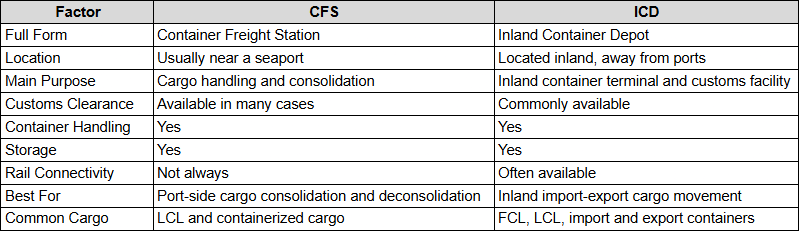
The most important difference is location and operational role.gyhy
A CFS usually supports cargo handling close to a port, while an ICD extends port-like facilities to inland locations.
What Is a Container Freight Station?
A Container Freight Station, commonly called a CFS, is a logistics facility where containerized cargo is handled before export or after import.
CFS facilities are typically located near major seaports and act as an intermediate point between the port and the shipper or consignee.
A CFS may be used for:
- Cargo consolidation
- Cargo deconsolidation
- Container stuffing
- Container de-stuffing
- Customs examination
- Temporary cargo storage
- Documentation
- Cargo sorting
- Container handling
- Transfer between trucks and containers
CFS facilities are especially important in LCL shipping, where multiple shipments are consolidated into one container.
What Is an Inland Container Depot?
An Inland Container Depot, or ICD, is an inland facility where containers can be handled, stored, cleared by customs, and transferred between transport modes.
ICDs are often described as dry ports because they provide many of the same services as a seaport, even though they are located inland.
An ICD can connect manufacturing and commercial regions to major ports through:
- Rail transportation
- Road transportation
- Multimodal logistics networks
ICDs are widely used in countries with large inland industrial regions, including India.
For businesses using sea freight forwarding services, ICDs can simplify container movement by bringing customs and cargo handling closer to the shipper.
What Is the Main Difference Between CFS and ICD?
The main difference between CFS and ICD is their location and scope of operations.
A CFS is usually located near a seaport and is primarily used for container-related cargo handling.
An ICD is located inland and often functions as a complete logistics terminal with customs clearance, container storage, and transport connectivity.
In simple terms:
CFS = cargo handling facility near the port.
ICD = inland dry port for containerized import and export cargo.
How Does a CFS Work?
The CFS process varies depending on whether the cargo is being imported or exported.
CFS Process for Imports
When import cargo arrives at a seaport:
- The container is discharged from the vessel.
- The container may be transferred from the port to a CFS.
- Customs documentation and examination may take place.
- Cargo may be de-stuffed from the container.
- Individual consignments are separated.
- Cargo is released to the importer or consignee.
This process is particularly common with LCL shipments.
CFS Process for Exports
For export cargo:
- The exporter sends cargo to the CFS.
- Cargo is checked and documented.
- Customs clearance may be completed.
- Multiple shipments may be consolidated.
- Cargo is stuffed into containers.
- Containers are moved to the port for vessel loading.
A CFS therefore helps manage containerized cargo before it enters or after it leaves the port.
How Does an ICD Work?
An ICD allows importers and exporters to complete many logistics activities inland instead of traveling directly to a seaport.
For exports, goods may move from a factory or warehouse to the ICD.
At the ICD:
- Cargo is received.
- Customs documentation is processed.
- Cargo may be examined.
- Containers are stuffed or sealed.
- Containers are transported by rail or road to the seaport.
- Containers are loaded onto the vessel.
For imports, the process works in reverse.
Containers arrive at the seaport and are transferred to the ICD, where customs clearance, unloading, and final cargo release can take place.
This can simplify Ocean Freight Forwarding for businesses located far from coastal ports.
CFS vs ICD in Customs Clearance
Both CFS and ICD facilities may support customs procedures, but ICDs usually provide a broader customs role.
Customs at a CFS
At a CFS, customs authorities may:
- Inspect cargo
- Verify documents
- Supervise stuffing and de-stuffing
- Approve cargo release
CFS facilities are often linked closely with nearby seaports.
Customs at an ICD
An ICD usually has a dedicated customs setup that can process both import and export shipments.
Businesses may complete customs formalities inland before containers move to or from a seaport.
For exporters located hundreds of kilometers from the coast, this can reduce operational complexity.
CFS vs ICD for LCL Shipping
CFS facilities play a particularly important role in Less than Container Load (LCL) shipping.
In LCL shipments, multiple exporters or importers share the same container.
A CFS is used to:
- Receive individual cargo shipments
- Consolidate them into one container
- Deconsolidate cargo at destination
- Store goods temporarily
- Separate shipments by consignee
Because of this, the term CFS is frequently associated with LCL Ocean Freight.
ICDs can also handle LCL cargo, but their role is broader and may include full container movements, customs clearance, and inland transportation.
CFS vs ICD for FCL Shipping
Full Container Load, or FCL, shipments typically involve one shipper using an entire container.
FCL containers may move through either CFS or ICD facilities depending on the shipment route and customs requirements.
An ICD can be particularly useful when an exporter is located far inland because containers can be processed and sealed before being transported to the seaport.
For importers, containers can similarly move from the port to an inland ICD for clearance and delivery.
Benefits of Using a CFS
A Container Freight Station can provide several benefits.
1. Easier Cargo Consolidation
CFS facilities make it easier to combine multiple smaller shipments into one container. This is valuable for LCL cargo.
2. Reduced Port Congestion
Moving cargo-related activities away from the main port terminal frees space inside the port.
3. Cargo Storage
CFS operators provide temporary storage before cargo pickup or shipment.
4. Customs Support
Many CFS locations offer customs examination and documentation facilities.
5. Efficient Container Handling
Stuffing, de-stuffing, and cargo segregation can be managed efficiently at a dedicated facility.
For businesses involved in sea freight services, a CFS provides a structured environment for managing containerized cargo close to the port.
Benefits of Using an ICD
ICDs provide significant advantages for inland businesses.
1. Port Services Closer to Manufacturing Hubs
Businesses located far from seaports can access customs and container services at inland locations.
2. Lower Transportation Complexity
Cargo can be consolidated and processed inland before being transported to the port.
3. Better Rail Connectivity
Many ICDs are connected to major ports through container rail networks.
This can reduce reliance on long-distance road transport.
4. Faster Customs Processing
Businesses can complete customs procedures inland instead of depending entirely on busy seaport facilities.
5. Improved Supply Chain Planning
ICDs allow exporters and importers to coordinate cargo closer to their factories, warehouses, or distribution centers.
This is particularly useful in large countries such as India, where industrial centers may be located far from coastal gateways.
CFS vs ICD in India
India has a large network of CFS and ICD facilities supporting domestic and international trade.
Major ports handle enormous volumes of containerized cargo, and inland logistics infrastructure helps distribute that activity across the country.
CFS Facilities in India
CFS facilities are commonly located near ports such as:
- Nhava Sheva / JNPT
- Chennai
- Mundra
- Kolkata
- Cochin
- Visakhapatnam
These facilities support container handling, storage, customs procedures, and cargo consolidation.
ICD Facilities in India
ICDs are located across inland logistics hubs and industrial regions.
They are often connected to major ports through road and rail networks.
For businesses using ocean freight services in India, ICDs can reduce the need to coordinate every shipment directly through a distant seaport.
CFS vs ICD Charges
Charges vary depending on the facility, cargo type, container size, storage duration, and services required.
Common CFS Charges
CFS charges may include:
- Container handling charges
- Cargo handling charges
- Stuffing charges
- De-stuffing charges
- Storage charges
- Documentation charges
- Customs examination charges
- Transportation charges
Common ICD Charges
ICD charges may include:
- Terminal handling
- Container movement
- Rail transportation
- Storage
- Customs handling
- Documentation
- Stuffing or de-stuffing
- Equipment handling
Importers and exporters should request a complete breakdown of charges before selecting a facility or booking freight.
CFS vs ICD vs Port: What's the Difference?
Although they are connected, a port, CFS, and ICD perform different functions.
Port
A seaport provides direct access to vessels and handles loading and unloading of containers from ships.
CFS
A CFS supports container and cargo handling, usually near the port.
ICD
An ICD brings port-like logistics and customs facilities to an inland location.
Together, these facilities form an important part of modern Ocean Freight & Shipping networks.
What Is a Dry Port?
A dry port is an inland terminal connected to a seaport by road or rail.
In many cases, an ICD is considered a type of dry port.
Dry ports allow businesses to handle containerized international trade without operating directly at the coastal port.
This can reduce road congestion, improve inland connectivity, and support logistics development around industrial centers.
How CFS and ICD Improve Supply Chain Efficiency
Both CFS and ICD facilities help reduce pressure on major seaports.
They provide additional locations for:
- Storage
- Container handling
- Customs examination
- Cargo consolidation
- Cargo distribution
This can improve the overall efficiency of international freight forwarding.
For example, instead of sending dozens of individual trucks directly into a congested port, cargo can be consolidated at an ICD or CFS before moving to the terminal.
How to Choose Between a CFS and an ICD
The right choice depends on several factors.
Choose a CFS when:
- Cargo is arriving or departing through a nearby seaport.
- You are shipping LCL cargo.
- Consolidation or deconsolidation is required.
- Temporary port-side storage is needed.
- Cargo requires examination or handling near the port.
Choose an ICD when:
- Your business is located far from a seaport.
- You want to complete customs clearance inland.
- Rail connectivity is available.
- You regularly move containerized cargo.
- You want to reduce direct dependence on seaport operations.
An experienced ocean freight forwarder can help determine which facility is most suitable for a particular trade route.
Example of CFS Usage
Suppose an exporter has only enough cargo to fill 25% of a container.
Instead of booking an entire container, the cargo can be sent to a CFS.
At the CFS, the shipment is combined with cargo from other exporters.
Once the container is full, it is sealed and moved to the seaport for export.
At the destination, another CFS may deconsolidate the container so each consignee receives their shipment.
This is a common process in LCL shipping.
Example of ICD Usage
Imagine a manufacturer located in an inland industrial city several hundred kilometers from the nearest seaport.
Instead of sending export cargo directly to the port, the manufacturer sends it to a nearby ICD.
At the ICD:
- Export documentation is processed.
- Customs clearance is completed.
- The container is sealed.
- The container is loaded onto rail or road transport.
- It moves directly to the gateway port.
This reduces the amount of logistics activity that needs to take place at the port itself.
What Documents Are Required at CFS and ICD Facilities?
Documentation requirements vary depending on the shipment, commodity, country, and customs regulations.
Common documents may include:
- Bill of lading
- Shipping bill
- Bill of entry
- Commercial invoice
- Packing list
- Certificate of origin
- Import-export code details
- Customs declarations
- Delivery order
- Container release documentation
Businesses should coordinate with their freight forwarder and customs broker to make sure all necessary documents are prepared correctly.
How Freight Forwarders Work With CFS and ICD Facilities
Freight forwarders coordinate cargo movement across ports, CFS facilities, ICDs, shipping lines, customs brokers, warehouses, and transporters.
Their role may include:
- Freight booking
- Container planning
- Cargo consolidation
- Documentation
- Customs coordination
- Port movement
- CFS handling
- ICD transportation
- Container tracking
- Final delivery
For companies using sea freight forwarding services, efficient coordination between these facilities can reduce delays and unnecessary costs.
How Zipaworld Supports CFS, ICD, and Ocean Freight Logistics
Managing international container shipments requires coordination between shipping lines, ports, inland terminals, customs authorities, trucking providers, and rail operators.
Zipaworld supports businesses with logistics solutions across Ocean Freight, freight forwarding, inland transportation, and supply chain coordination.
For businesses using CFS or ICD facilities, effective planning can help improve cargo visibility, reduce delays, simplify customs coordination, and optimize container movement.
Whether your shipment moves through a port-side CFS or an inland ICD, selecting the right logistics route can improve overall supply chain efficiency.
Final Takeaway
CFS and ICD facilities are both important components of international container logistics, but they serve different roles.
A Container Freight Station primarily supports cargo consolidation, deconsolidation, storage, and container handling close to the port.
An Inland Container Depot extends container terminal and customs facilities to inland locations, helping businesses move cargo efficiently between industrial regions and seaports.
For businesses using Ocean Freight Forwarding, understanding CFS vs ICD can help improve route planning, reduce delays, optimize transportation costs, and simplify customs operations.
Choosing the right facility depends on cargo type, shipment size, business location, port connectivity, customs requirements, and transportation strategy.
With effective logistics coordination and the right freight forwarding partner, both CFS and ICD facilities can play a valuable role in creating a more efficient international supply chain.