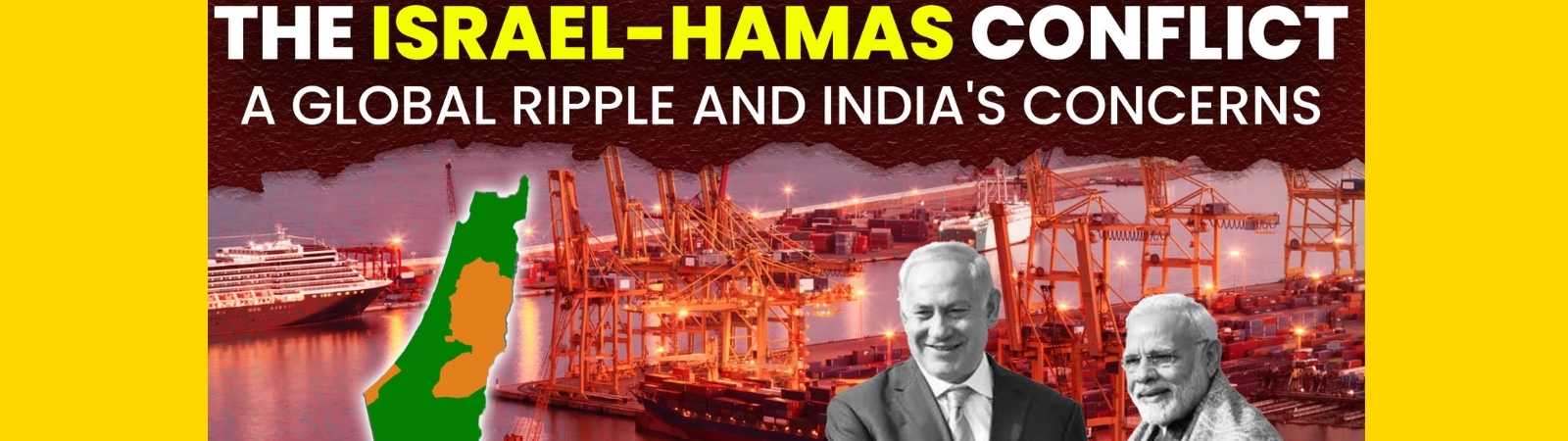
Israel-Hamas Conflict: A Global Ripple
The world is currently witnessing a significant geopolitical event - the Israel-Hamas conflict. What started as an attack on the 7th of October has now escalated into a full-scale war. This conflict has caused numerous deaths and extensive damage, leading to a dire situation for the people in the region. The Israeli Prime Minister has officially declared that the country is at war. This conflict is not just a local issue; it has the potential to disrupt the global supply chain and has raised serious concerns, particularly for India.
Understanding the Current Issue
Israel, with its remarkable economic growth in recent years, ranks among the top economies globally. In 2022, The Economist listed Israel as the 4th most successful economy among developed countries. This is crucial because Israel serves as a significant hub for trade and transportation, making it a linchpin in the global economy. Its strategic location plays a vital role in connecting the East and the West, and any disruption here can send shockwaves across the world.
Israel's top exports, including diamonds, integrated circuits, and refined petroleum, are essential to the global market. Moreover, the country's major trading partners, such as the United States, China, and India, could face substantial disruptions if the conflict continues to escalate.
Potential Risks to the Global Economy
The global economy operates as an intricate web of interlinked trade and commerce. Thus, any disturbance in a major economic player like Israel can have severe repercussions worldwide. As the conflict continues, logistics costs are on the rise. Disrupted supply chains make the transportation of goods more challenging and expensive.
This surge in logistics costs can contribute to inflation worldwide, which can affect the prices of goods and services, creating the potential for a global inflation crisis.
Impact on India
India has a strong trade and geopolitical relationship with Israel. In the fiscal year 2022-23, Indian merchandise exports to Israel reached $7.89 billion, and Israeli exports to India amounted to $2.13 billion. Additionally, bilateral trade in services stood at USD 1.1 billion in 2021. Any disruption in trade with Israel can adversely affect India's economy, potentially leading to supply shortages and economic challenges.
Historical Context and Energy Prices
The world has seen the global economy teeter on the edge due to energy-related crises in the past. In 1974, the world faced an energy crisis that sent energy prices skyrocketing. This crisis occurred due to geopolitical tensions and disruptions in the energy supply.
Today, the energy market remains highly sensitive to geopolitical tensions. If the Israel-Hamas conflict continues to escalate, energy prices could surge, potentially triggering a global recession reminiscent of the 1974 energy crisis.
Conclusion
In conclusion, the Israel-Hamas conflict is not just a local issue but has far-reaching consequences. It threatens regional stability and has the potential to disrupt the global economy, logistics costs, inflation, and energy prices. India, with its strong ties to Israel, is not immune to these challenges.
The world watches with concern, hoping for a peaceful resolution to this escalating crisis. It is a stark reminder that in our interconnected world, the consequences of geopolitical conflicts can extend far beyond the borders of the nations involved.