Cross-Border Trucking: Documentation and Process
Cross-border trucking plays a critical role in international trade, especially for businesses moving goods between neighboring countries or across connected land routes.
Unlike domestic road transport, cross-border trucking involves customs formalities, multiple transport documents, border inspections, taxes, permits, and coordination between shippers, carriers, freight forwarders, customs brokers, and authorities on both sides of the border.
A small documentation error can delay cargo, increase storage costs, create customs penalties, or disrupt delivery schedules.
For importers, exporters, manufacturers, eCommerce businesses, and supply chain teams, understanding the cross-border trucking process is essential for maintaining smooth international cargo movement.
This guide explains how cross-border road freight works, what documents are typically required, the main steps involved, common challenges, and how businesses can reduce delays at international borders.
What Is Cross-Border Trucking?
Cross-border trucking is the movement of commercial goods by road from one country to another.
It may involve:
- Full Truck Load, or FTL
- Less than Truck Load, or LTL
- Containerized cargo
- Palletized shipments
- Refrigerated cargo
- Dangerous goods
- High-value cargo
- Express road freight
- Multimodal shipments
The truck may move directly from the origin country to the destination country, or the cargo may be transferred between vehicles at a border point depending on local regulations and operating models.
Cross-border road transport is commonly used when road connectivity is strong and the origin and destination are geographically close enough to make trucking practical.
Cross-Border Trucking Process: Quick Overview
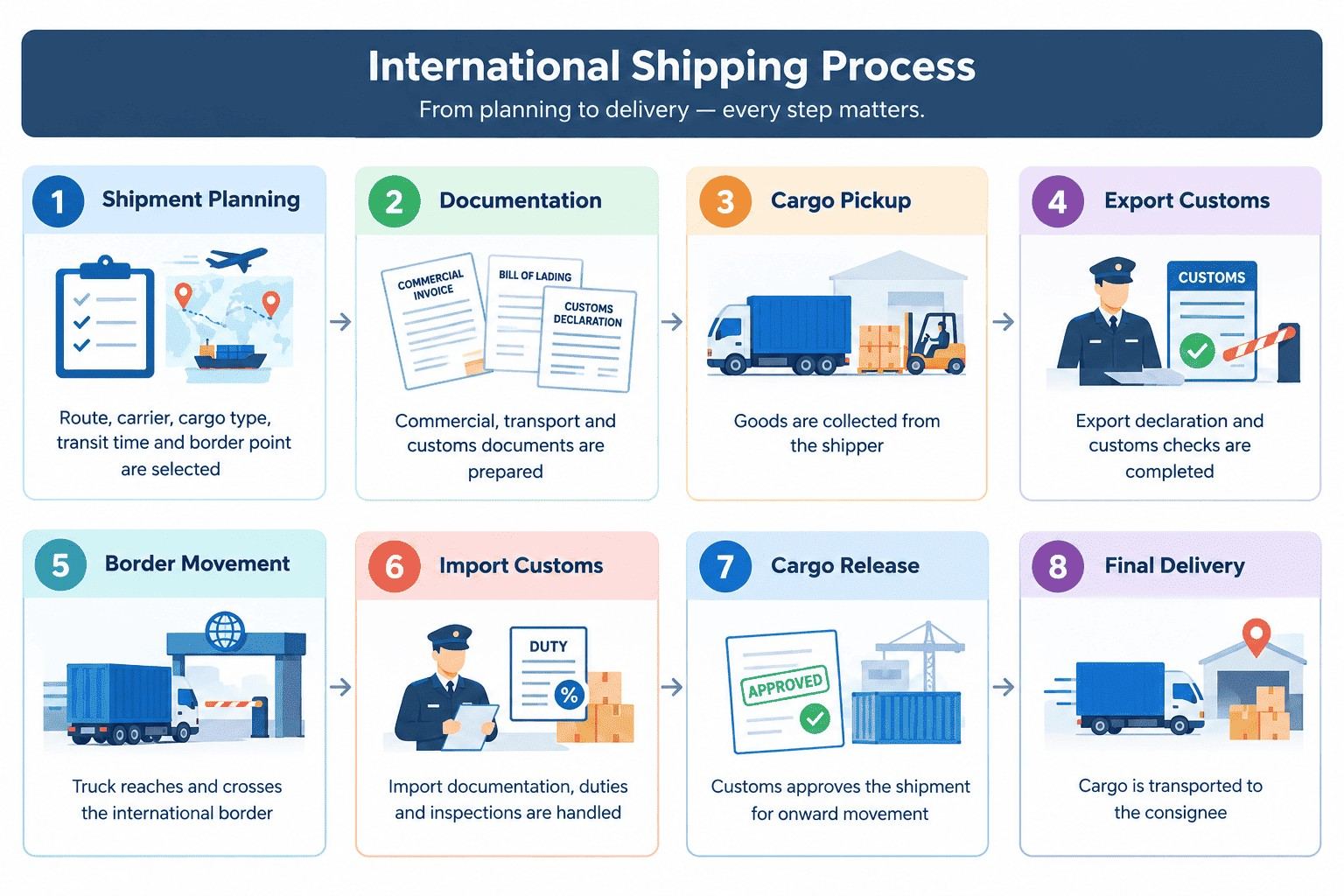
NOTE - The exact process varies by country, trade agreement, commodity, border point, and shipment type.
Why Cross-Border Trucking Is Important
Cross-border road freight offers several advantages for regional trade.
It can provide:
- Direct door-to-door transportation
- Faster transit than sea freight for short regional routes
- Greater flexibility than rail in many markets
- Easy access to inland cities
- Frequent departures
- Flexible shipment sizes
- Integration with warehouses and distribution centers
- Support for just-in-time supply chains
For businesses operating within regional trade corridors, international road freight can often provide an efficient alternative to air or sea transportation.
What Documents Are Required for Cross-Border Trucking?
The required documents depend on the countries involved, cargo type, customs rules, and trade terms.
However, several documents are commonly used.
1. Commercial Invoice
The commercial invoice is one of the most important documents in international trade.
It usually includes:
- Seller details
- Buyer details
- Description of goods
- Quantity
- Unit price
- Total shipment value
- Currency
- Country of origin
- Incoterms
- Payment terms
Customs authorities use the commercial invoice to assess the declared value of goods and calculate duties and taxes where applicable.
Incorrect or incomplete invoice details can delay customs clearance.
2. Packing List
The packing list provides detailed information about how the cargo is packed.
It may include:
- Number of cartons
- Pallet count
- Package dimensions
- Gross weight
- Net weight
- Package markings
- Product quantities
Customs officers and logistics providers may use the packing list during inspections and cargo verification.
3. Road Consignment Note
A road consignment note records the transportation agreement between the shipper and road carrier.
Depending on the countries involved, this may take the form of a CMR consignment note or another locally recognized road transport document.
It commonly includes:
- Shipper details
- Consignee details
- Carrier details
- Pickup location
- Delivery location
- Description of goods
- Number of packages
- Weight
- Transport instructions
The consignment note acts as an important transport record throughout the journey.
4. Certificate of Origin
A Certificate of Origin confirms the country where the goods were produced or manufactured.
This can be particularly important when a shipment qualifies for reduced tariffs under a trade agreement.
Customs authorities may request the certificate to determine:
- Applicable import duties
- Trade agreement eligibility
- Origin restrictions
- Product compliance
Incorrect origin documentation can result in additional duties or customs disputes.
5. Export Declaration
The exporter may need to submit an export customs declaration before goods leave the origin country.
This document typically identifies:
- Exporter
- Commodity
- Customs classification
- Shipment value
- Destination
- Transport mode
- Quantity
The process may be electronic depending on the country.
6. Import Declaration
The importer or customs broker typically submits an import declaration at the destination.
It provides customs authorities with the information required to assess and release the shipment.
The declaration may include:
- Importer details
- HS code
- Customs value
- Country of origin
- Applicable duties
- Taxes
- Product details
Accurate classification and valuation are important to avoid delays.
7. HS Code Information
The Harmonized System code, or HS code, is used to classify goods for customs purposes.
The HS code helps determine:
- Import duties
- Taxes
- Restrictions
- Documentation requirements
- Trade policy measures
Using the wrong HS code can result in penalties, reassessments, or cargo holds.
8. Import or Export Licenses
Some goods require government licenses or permits.
Examples may include:
- Pharmaceuticals
- Chemicals
- Food products
- Agricultural products
- Weapons
- Controlled technologies
- Certain electronics
- Hazardous materials
Businesses should confirm whether permits are required before the cargo is dispatched.
9. Insurance Certificate
An insurance certificate may be required to confirm that goods are covered during international transportation.
Cargo insurance can protect against risks such as:
- Theft
- Damage
- Accidents
- Fire
- Handling losses
- Certain transit disruptions
The exact coverage depends on the insurance policy.
10. Driver and Vehicle Documentation
The truck and driver may also need specific documents.
These can include:
- Driver license
- Passport or identification
- Visa where applicable
- Vehicle registration
- Road permits
- Insurance
- Cross-border operating permits
- Temporary import documents for the vehicle
Requirements vary significantly between countries.
Step-by-Step Cross-Border Trucking Process
Understanding the complete process can help businesses identify where delays are most likely to happen.
Step 1: Plan the Shipment
The shipper or freight forwarder first determines:
- Origin
- Destination
- Cargo type
- Shipment weight
- Shipment dimensions
- Delivery deadline
- Required truck type
- Border crossing point
- Customs requirements
The logistics provider then selects the most suitable route and trucking service.
Step 2: Confirm Incoterms
Incoterms define the responsibilities of the buyer and seller.
They determine who is responsible for:
- Transportation
- Customs clearance
- Insurance
- Risk transfer
- Duties
- Taxes
Common Incoterms used in road freight include:
- EXW
- FCA
- CPT
- CIP
- DAP
- DDP
Businesses should clearly agree on Incoterms before dispatch.
Step 3: Prepare Documentation
All required commercial, customs, and transport documents should be prepared before cargo pickup.
This can include:
- Commercial invoice
- Packing list
- Certificate of origin
- Export declaration
- Import permits
- Transport documents
- Insurance documents
Pre-checking documents can help reduce border delays.
Step 4: Cargo Pickup
The truck collects the goods from the shipper’s warehouse or factory.
Before departure, the carrier may verify:
- Package count
- Cargo condition
- Weight
- Seals
- Labels
- Transport instructions
For controlled or high-value cargo, additional security procedures may apply.
Step 5: Export Customs Clearance
Before crossing the border, export customs procedures must be completed.
The customs authority may:
- Verify documents
- Review HS codes
- Inspect cargo
- Check permits
- Confirm export eligibility
Once cleared, the shipment can proceed toward the border.
Step 6: Border Crossing
The truck arrives at the international border checkpoint.
Depending on the countries involved, authorities may review:
- Driver documents
- Truck documents
- Cargo declarations
- Seals
- Customs paperwork
- Certificates
- Permits
- Cargo may be scanned or physically inspected.
Border processing time can vary based on traffic, documentation accuracy, customs procedures, and security controls.
Step 7: Import Customs Clearance
At the destination side, customs authorities review the shipment before allowing it to enter the country.
The importer or customs broker may need to:
- Submit an import declaration
- Provide invoices
- Confirm HS codes
- Pay duties
- Pay taxes
- Provide licenses
- Arrange inspections
Once customs clearance is complete, the goods can be released.
Step 8: Final Delivery
After release, the truck continues to the consignee’s warehouse, factory, or distribution center.
The receiver checks:
- Cargo quantity
- Package condition
- Seal condition
- Delivery documents
Proof of delivery may then be issued.
What Is Customs Clearance in Cross-Border Trucking?
Customs clearance is the process of obtaining permission from customs authorities to export goods from one country and import them into another.
It is one of the most important parts of international trucking.
Customs clearance usually involves:
- Documentation verification
- Product classification
- Customs valuation
- Duty calculation
- Tax calculation
- Permit checks
- Risk assessment
- Inspections
A customs broker or freight forwarder often assists with this process.
What Is a Bonded Truck?
A bonded truck or bonded movement refers to cargo transported under customs control before final import clearance.
The cargo may travel from:
- Border point to inland customs facility
- Port to bonded warehouse
- Airport to customs terminal
- Inland terminal to another bonded location
Bonded transportation allows goods to move without completing full customs clearance at the initial entry point.
This can be useful in complex multimodal logistics networks.
What Is Transshipment at the Border?
In some cross-border trucking models, the same truck cannot operate in both countries.
In such cases, cargo may be transferred from one truck to another at the border.
This is known as transshipment.
For example: Truck from Country A → Border Terminal → Cargo Transfer → Truck from Country B
Transshipment may be required because of:
- Vehicle regulations
- Driver permits
- Bilateral transport agreements
- Security rules
- Operating restrictions
Although transshipment adds an extra handling stage, it is common on some international road freight routes.
Cross-Border Trucking vs Domestic Trucking
The main difference is customs and regulatory complexity.
Domestic Trucking
Usually involves:
- One legal jurisdiction
- No international customs border
- Simpler documentation
- Fewer regulatory approvals
Cross-Border Trucking
Usually involves:
- Export customs
- Import customs
- International transport documents
- Duties and taxes
- Certificates of origin
- Border inspections
- Driver and vehicle permits
- Compliance with two or more jurisdictions
This is why cross-border freight requires more planning.
Cross-Border Trucking vs Air Freight
Cross-border road freight can be a practical alternative to air freight services for regional shipments.
Air Freight
Best suited for:
- Urgent cargo
- High-value goods
- Long-distance international shipments
- Lightweight products
Cross-Border Trucking
Best suited for:
- Regional trade
- Door-to-door cargo
- Medium and large shipments
- Flexible delivery routes
Road freight can offer a balance between transit time and transportation cost.
Cross-Border Trucking vs Sea Freight
Cross-border trucking is usually much faster than sea freight for neighboring countries connected by road.
Sea freight, however, may be more economical for very large volumes or long-distance international transportation.
For regional trade, trucking provides direct inland connectivity without requiring port handling.
For global trade, road transport often works together with Ocean Freight Forwarding for first-mile and last-mile movement.
Common Challenges in Cross-Border Trucking
Cross-border road freight can face several operational challenges.
1. Incomplete Documentation
Missing or inaccurate documents are among the most common causes of border delays.
2. Customs Inspections
Cargo may be selected for physical examination.
3. Incorrect HS Codes
Incorrect classification can result in reassessment or penalties.
4. Duty and Tax Issues
Unpaid or incorrectly calculated duties can delay cargo release.
5. Border Congestion
High truck volumes can create long queues.
6. Permit Problems
Drivers or vehicles may lack required cross-border authorization.
7. Cargo Restrictions
Certain products may require special licenses.
8. Language and Regulatory Differences
Different rules across countries can create operational complexity.
How to Avoid Delays in Cross-Border Trucking
Businesses can reduce delays through careful preparation.
1. Prepare Documents Before Dispatch
Do not wait until the truck reaches the border.
2. Verify HS Codes
Confirm customs classification before the shipment leaves.
3. Check Import Restrictions
Make sure the destination country allows the product.
4. Confirm Driver and Vehicle Permits
Verify all cross-border permits in advance.
5. Pre-Clear Customs Where Possible
Some customs systems allow documentation to be submitted before arrival.
6. Choose the Right Border Crossing
Some checkpoints may be more suitable for specific cargo types.
7. Track the Shipment
Shipment visibility helps logistics teams respond quickly to delays.
8. Work With Experienced Partners
A freight forwarder familiar with the trade lane can help coordinate customs, trucking, and documentation.
How to Reduce Cross-Border Trucking Costs
Cost optimization should focus on the complete logistics process rather than only the trucking rate.
Businesses can reduce costs by:
- Consolidating smaller shipments
- Selecting efficient routes
- Avoiding unnecessary border waiting
- Preparing correct documentation
- Reducing customs delays
- Using return loads
- Improving vehicle utilization
- Selecting appropriate Incoterms
- Coordinating warehouse delivery slots
Efficient planning can reduce both transportation and delay-related costs.
Role of Freight Forwarders in Cross-Border Trucking
An experienced freight forwarder can coordinate multiple aspects of international road transportation.
Services may include:
- Carrier selection
- Route planning
- Documentation support
- Customs coordination
- Cargo consolidation
- Border crossing management
- Shipment tracking
- Final delivery coordination
For businesses handling multiple international shipments, freight forwarding services can reduce the complexity of dealing with several carriers and customs authorities separately.
Role of Technology in Cross-Border Road Freight
Digital logistics platforms can improve shipment visibility and coordination.
Technology can support:
- Real-time shipment tracking
- Electronic documentation
- Customs status updates
- Route monitoring
- Estimated arrival times
- Exception alerts
- Carrier coordination
- Document storage
Better visibility can help businesses identify potential border delays before they affect customers.
Example of a Cross-Border Trucking Shipment
Consider a manufacturer shipping commercial goods from one country to a neighboring market.
The process may look like this: Factory → Truck Pickup → Export Customs → Border Crossing → Import Customs → Inland Transport → Customer Warehouse
Before departure, the exporter prepares the commercial invoice, packing list, transport document, certificate of origin, and customs information.
At the border, authorities verify the truck, driver, cargo, and documentation.
After import customs clearance, the same truck or a destination-country vehicle completes final delivery.
This illustrates why documentation and coordination are essential in cross-border trucking.
When Should Businesses Choose Cross-Border Trucking?
Cross-border road freight can be particularly suitable when:
1. Origin and Destination Are in Neighboring Countries
Road freight provides direct regional connectivity.
2. Door-to-Door Delivery Is Important
Trucks can usually move directly between factories and warehouses.
3. Cargo Is Too Large for Courier Shipping
Commercial shipments can move efficiently through FTL or LTL services.
4. Transit Time Matters
Cross-border trucking can be faster than sea transport on regional routes.
5. Businesses Need Flexible Transportation
Road freight offers route and scheduling flexibility.
How Zipaworld Supports Cross-Border Freight Movement
Cross-border trucking requires coordination across carriers, customs authorities, drivers, border checkpoints, warehouses, and customers.
Zipaworld supports businesses with logistics solutions across road freight, freight forwarding, customs coordination, and multimodal transportation.
For businesses managing international road shipments, an effective logistics strategy should consider:
- Cargo type
- Shipment size
- Border regulations
- Documentation
- Customs requirements
- Route selection
- Transit time
- Driver permits
- Vehicle requirements
- Final delivery arrangements
By coordinating these elements effectively, businesses can reduce delays and improve the reliability of cross-border cargo movement.
Final Takeaway
Cross-border trucking can provide fast, flexible, and direct cargo movement between neighboring countries, but it requires more documentation and regulatory coordination than domestic road transport.
The key to successful cross-border road freight is preparation.
Businesses should ensure commercial invoices, packing lists, customs declarations, HS codes, certificates, permits, transport documents, and driver paperwork are accurate before the truck reaches the border.
Effective customs planning, route selection, shipment tracking, and carrier coordination can reduce waiting times and help prevent costly disruptions.
For importers and exporters, cross-border trucking works best as part of a broader logistics strategy that may also include Road Freight, Rail Freight, Air Freight, Ocean Freight, and multimodal transportation.
With the right freight forwarding and customs coordination, businesses can move international cargo more efficiently and maintain more predictable delivery schedules.