Bonded Warehousing Explained: Benefits for Importers
For importers, one of the biggest challenges in international trade is managing customs duties, inventory timing, storage, and cash flow after goods arrive in the destination country.
A bonded warehouse can help solve several of these challenges.
A bonded warehouse is a customs-controlled storage facility where imported goods can be stored without immediately paying import duties and taxes. Customs charges are generally deferred until the goods are released into the domestic market.
For businesses importing goods in bulk, managing seasonal inventory, or re-exporting products, bonded warehousing can provide greater flexibility and better control over working capital.
This guide explains what bonded warehousing is, how it works, the key benefits for importers, the documents involved, and when businesses should consider using a bonded warehouse.
What is a Bonded Warehouse?
A bonded warehouse is a secured storage facility approved or supervised by customs authorities where imported goods can be stored before customs duties and taxes are paid.
The goods remain under customs control while they are inside the bonded facility.
Importers generally pay the applicable duties and taxes only when the goods are removed from the warehouse for domestic consumption.
If the goods are re-exported instead, import duties may not become payable, depending on applicable regulations.
In simple terms: Bonded warehouse = customs-controlled storage with deferred import duty payment.
This makes bonded warehousing useful for businesses that want to delay customs payments until inventory is actually needed.
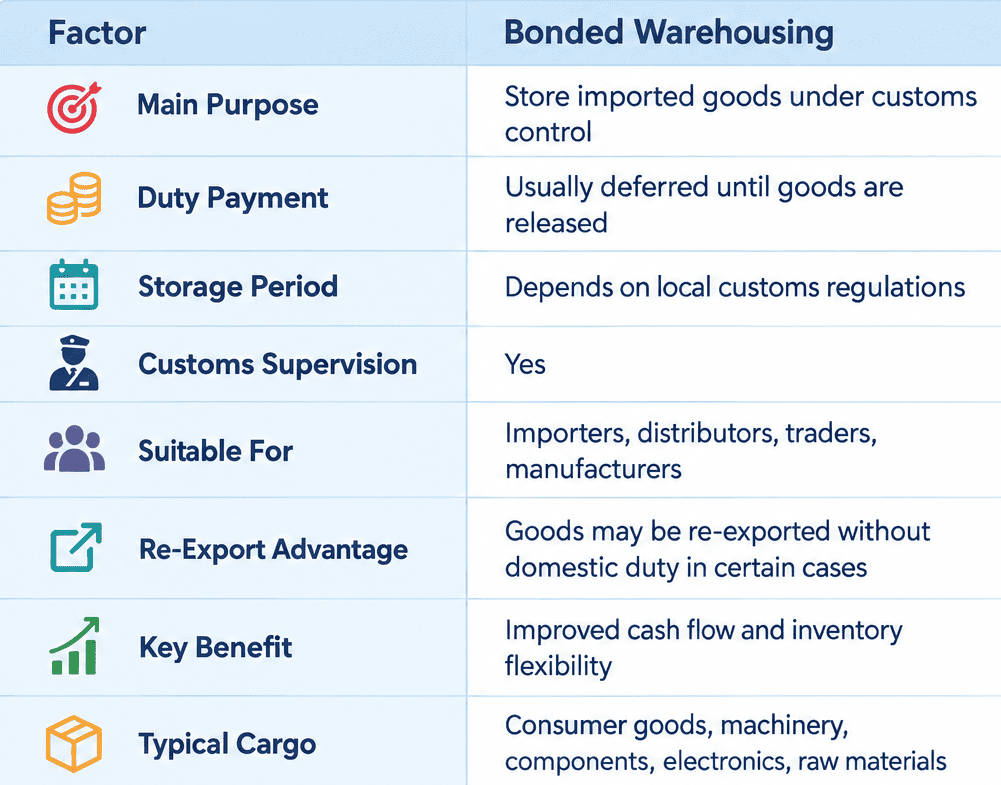
Bonded Warehousing: Quick Overview
How Does Bonded Warehousing Work?
The bonded warehousing process typically begins when imported goods arrive at a port, airport, or inland customs facility.
Instead of immediately clearing the goods for domestic consumption, the importer moves them into a bonded warehouse.
A typical process may look like this:
- Goods arrive in the destination country.
- Import documentation is submitted.
- Customs approves movement into a bonded facility.
- Goods are transported under customs control.
- Cargo is stored in the bonded warehouse.
- Duties and taxes remain deferred.
- Goods are released as needed.
- Duties and taxes are paid when the goods enter the domestic market.
If the cargo is re-exported, different customs treatment may apply.
Why Do Importers Use Bonded Warehouses?
Importers often use bonded warehouses because they reduce the need to pay customs duties immediately on all imported inventory.
This can be particularly useful when:
- Goods are imported in large quantities
- Inventory will be sold gradually
- Products may be re-exported
- Demand is uncertain
- Seasonal stock needs to be held
- Working capital needs to be preserved
Instead of paying duties on an entire shipment immediately, businesses may be able to pay only when individual quantities are released.
Key Benefits of Bonded Warehousing for Importers
Bonded warehousing offers several important advantages.
1. Deferred Customs Duty Payments
The most important benefit is duty deferment.
Importers can store goods without immediately paying import duties and taxes.
This can improve cash flow because funds remain available for other business needs.
For example, if a company imports a large shipment but only sells a portion each month, it may be able to pay duties gradually as goods leave the bonded warehouse.
2. Better Working Capital Management
Paying customs duties upfront can tie up a significant amount of capital.
Bonded warehousing can help businesses preserve working capital by delaying those payments.
This may allow companies to use funds for:
- Purchasing more inventory
- Marketing
- Production
- Payroll
- Distribution
- Business expansion
For high-volume importers, this financial flexibility can be significant.
3. Useful for Re-Exporting Goods
Bonded warehouses can be especially valuable for businesses that import goods and later re-export them to another country.
In certain circumstances, goods that never enter the domestic market may be re-exported without becoming subject to local import duties.
This makes bonded warehousing useful for:
- Trading companies
- Regional distribution hubs
- Global supply chains
- Re-export businesses
- International eCommerce operations
4. Flexible Inventory Management
Bonded warehousing allows importers to hold goods until they are actually needed.
This provides flexibility in managing inventory according to market demand.
Businesses can release goods in smaller batches rather than clearing an entire shipment at once.
This can reduce overstocking and improve inventory planning.
5. Better Support for Seasonal Demand
Seasonal businesses often need to import inventory months before peak demand.
Bonded warehousing allows them to bring goods into the country early without necessarily paying duties immediately.
The inventory can then be released gradually as demand increases.
This can be useful for:
- Holiday products
- Fashion
- Electronics
- Consumer goods
- Promotional merchandise
- Seasonal industrial products
6. Reduced Pressure on Port Storage
Ports and terminals generally charge storage fees when cargo remains beyond the permitted free period.
Moving goods into a bonded warehouse can help importers avoid excessive port storage costs.
It can also reduce the risk of demurrage and detention caused by delayed cargo pickup.
7. Improved Supply Chain Flexibility
Bonded warehousing provides an additional layer of flexibility between import arrival and domestic distribution.
Businesses can use bonded facilities to:
- Hold stock
- Consolidate cargo
- Deconsolidate shipments
- Repackage products
- Label goods
- Prepare orders
- Plan downstream distribution
The specific activities permitted depend on customs rules and facility authorization.
Bonded Warehouse vs Regular Warehouse
The main difference is customs status.
Bonded Warehouse - Goods remain under customs control, and import duties are deferred.
Regular Warehouse - Goods have generally already cleared customs, and applicable duties and taxes have been paid.
Bonded Warehouse vs Free Trade Zone
Bonded warehouses and Free Trade Zones can both offer customs-related advantages, but they are not the same.
A bonded warehouse is usually a customs-approved facility focused on storing imported goods under bond.
A Free Trade Zone may offer broader benefits such as:
- Duty deferment
- Re-export advantages
- Manufacturing permissions
- Processing
- Repacking
- Regional distribution
The exact benefits depend on the jurisdiction.
Businesses should evaluate both options based on their supply chain model.
Bonded Warehouse vs Customs Warehouse
The terms are sometimes used interchangeably, but local regulations may distinguish between different types of customs-controlled storage facilities.
A customs warehouse generally refers to a facility authorized to store goods under customs control.
A bonded warehouse is typically a type of customs-controlled warehouse where duty payment is suspended until goods are released. Terminology can vary by country.
What Goods Can Be Stored in a Bonded Warehouse?
Bonded warehouses can store many types of imported goods.
Common examples include:
● Electronics
● Machinery
● Industrial components
● Consumer goods
● Apparel
● Automotive parts
● Food products
● Beverages
● Chemicals
● Raw materials
● Luxury goods
● Spare parts
However, certain products may require special approvals.
Examples include:
● Hazardous goods
● Pharmaceuticals
● Alcohol
● Tobacco
● Controlled chemicals
● Perishable goods
Importers should confirm whether the bonded facility is licensed for the specific cargo type.
What Documents Are Required for Bonded Warehousing?
The exact documentation depends on customs regulations and the type of goods.
Common documents may include:
● Bill of lading or airway bill
● Commercial invoice
● Packing list
● Import declaration
● Warehouse entry document
● Bond documentation
● Certificate of origin
● Customs transit document
● Import license where required
● Insurance documents
Accurate documentation is important because bonded goods remain under customs supervision.
What Is a Customs Bond?
A customs bond is a financial guarantee that ensures the importer or warehouse operator will comply with customs obligations.
It may cover:
● Duties
● Taxes
● Penalties
● Customs compliance requirements
If goods are released improperly or customs obligations are not fulfilled, the bond may be used to recover the amount owed.
Bond requirements vary by country.
How Long Can Goods Stay in a Bonded Warehouse?
The permitted storage period depends on local customs regulations.
Some jurisdictions allow goods to remain bonded for several months or years, while others have specific time limits.
Importers should confirm:
● Maximum bonded storage period
● Renewal requirements
● Customs approval rules
● Applicable warehouse charges
Keeping goods beyond the permitted period may lead to penalties or forced clearance.
Can Goods Be Repacked in a Bonded Warehouse?
In many bonded facilities, certain activities may be allowed under customs supervision.
These may include:
● Repacking
● Relabeling
● Sorting
● Inspection
● Sampling
● Consolidation
● Deconsolidation
More complex processing or manufacturing may require separate authorization.
Importers should always verify permitted operations in advance.
Can Goods Be Sold While in Bonded Storage?
In some cases, ownership of bonded goods can be transferred while the goods remain in the warehouse.
However, customs duties are still generally payable when the goods are released for domestic consumption.
The exact legal and tax implications vary by country.
How Bonded Warehousing Helps With Cash Flow
Consider an importer bringing goods worth a large amount into the country.
If the importer must immediately pay customs duties on the full shipment, a substantial amount of cash becomes tied up before the products are sold.
With bonded warehousing, the importer may release only a portion of the goods each month.
Duties are then paid progressively as inventory enters the domestic market.
This aligns customs payments more closely with sales and inventory movement.
Example of Bonded Warehousing for Importers
Suppose a company imports 10,000 units of consumer electronics.
Only 2,000 units are expected to be sold during the first month.
Instead of clearing all 10,000 units immediately, the importer stores the full shipment in a bonded warehouse.
The company releases 2,000 units and pays duties only on that quantity.
The remaining 8,000 units stay bonded.
If demand changes, the importer can adjust future releases.
This provides greater flexibility than paying duties upfront on all inventory.
Bonded Warehousing and Ocean Freight
Bonded warehousing is closely connected with Ocean Freight and containerized imports.
A typical import process may look like this: Supplier → Ocean Freight → Destination Port → Customs Transit → Bonded Warehouse → Domestic Distribution
This can help importers avoid leaving containers at the port for long periods.
Once cargo is moved out of the terminal and into a bonded facility, businesses can manage inventory more strategically.
For companies using Ocean Freight Forwarding, bonded warehousing can become an important part of the import supply chain.
Bonded Warehousing and Air Freight
Bonded warehousing is also useful for air cargo.
High-value or time-sensitive imports may arrive through air freight services but still require controlled storage before customs clearance.
A bonded facility near an airport can help businesses manage:
● High-value goods
● Electronics
● Pharmaceuticals
● Spare parts
● Express commercial shipments
This allows importers to combine fast transport with flexible customs clearance.
Role of Freight Forwarders in Bonded Warehousing
A freight forwarder can help coordinate the movement of goods into and out of bonded storage.
Services may include:
● Freight booking
● Customs documentation
● Bonded transportation
● Warehouse coordination
● Customs clearance
● Cargo tracking
● Final delivery
For businesses handling international shipments regularly, freight forwarding services can simplify coordination between carriers, ports, customs authorities, and warehouses.
What Is Bonded Transportation?
Bonded transportation refers to moving imported goods from one customs-controlled location to another without paying duties at the first point of arrival.
For example: Port → Bonded Truck → Bonded Warehouse
The cargo remains under customs control during transportation.
This allows goods to move away from congested ports while maintaining customs status.
How Bonded Warehousing Can Reduce Demurrage
Demurrage can occur when containers remain at a port beyond free time.
Importers can reduce this risk by moving cargo out of the terminal quickly and into a bonded warehouse.
The general strategy is:
- Container arrives.
- Customs transit is arranged.
- Container leaves the port.
- Cargo moves to a bonded facility.
- Import clearance is completed later.
This can help reduce port-related storage and delay charges.
However, businesses must still manage container return deadlines to avoid detention.
Common Challenges of Bonded Warehousing
Bonded warehousing also has limitations.
1. Warehouse Fees - Bonded facilities charge storage and handling fees.
2. Customs Compliance - Goods remain under customs control, so strict recordkeeping is required.
3. Limited Operations - Not every type of processing may be permitted.
4. Time Limits - Some countries limit how long goods can remain bonded.
5. Additional Documentation - Bonded movements can require more paperwork than regular storage.
6. Specialized Facility Requirements - Certain goods require temperature-controlled or hazardous-material facilities.
Businesses should compare the benefits with total operating costs.
How to Choose a Bonded Warehouse
Importers should evaluate several factors before selecting a facility.
Location - Choose a warehouse close to:
● Ports
● Airports
● ICDs
● Distribution centers
● Major highways
Customs Authorization - Confirm that the facility is officially approved for bonded storage.
Cargo Capability - Check whether the warehouse can handle your goods.
Security - High-value cargo may require enhanced security.
Technology - Look for:
● Inventory visibility
● Barcode systems
● Real-time tracking
● Digital documentation
Cost - Compare:
● Storage fees
● Handling charges
● Bonded transfer costs
● Customs fees
● Value-added service charges
When Should Importers Use Bonded Warehousing?
Bonded warehousing may be particularly useful when:
1. You Import Large Volumes - Bulk imports can create significant upfront duty obligations.
2. Goods Will Be Sold Gradually - Duty deferment can match customs payments with inventory sales.
3. You May Re-Export Goods - Bonded storage can support regional distribution models.
4. Demand Is Uncertain - Inventory can remain bonded until required.
5. You Want to Reduce Port Storage - Moving cargo into a warehouse can reduce exposure to port charges.
6. You Need Better Working Capital Control - Deferred customs payments can improve cash flow.
How Zipaworld Supports Bonded Warehousing and Import Logistics
Managing bonded inventory requires coordination across freight carriers, customs authorities, bonded transporters, warehouses, and final delivery networks.
Zipaworld supports businesses with logistics solutions across freight forwarding, Ocean Freight, Air Freight, customs coordination, warehousing, and multimodal transportation.
For importers considering bonded warehousing, an effective logistics strategy should evaluate:
● Import volume
● Duty exposure
● Storage duration
● Customs requirements
● Inventory turnover
● Re-export plans
● Warehouse location
● Transportation costs
● Final distribution needs
By combining bonded warehousing with efficient freight and customs planning, businesses can improve inventory control, reduce cash-flow pressure, and build more flexible import operations.